Similar to the Bipolar I vs Bipolar II note I just decided to actually look into it
I’d always felt that self harm tracked hard with addiction behaviorally, and I’d also assumed to know why I most of my feels around it where that of warm and fuzzy nostalgia.
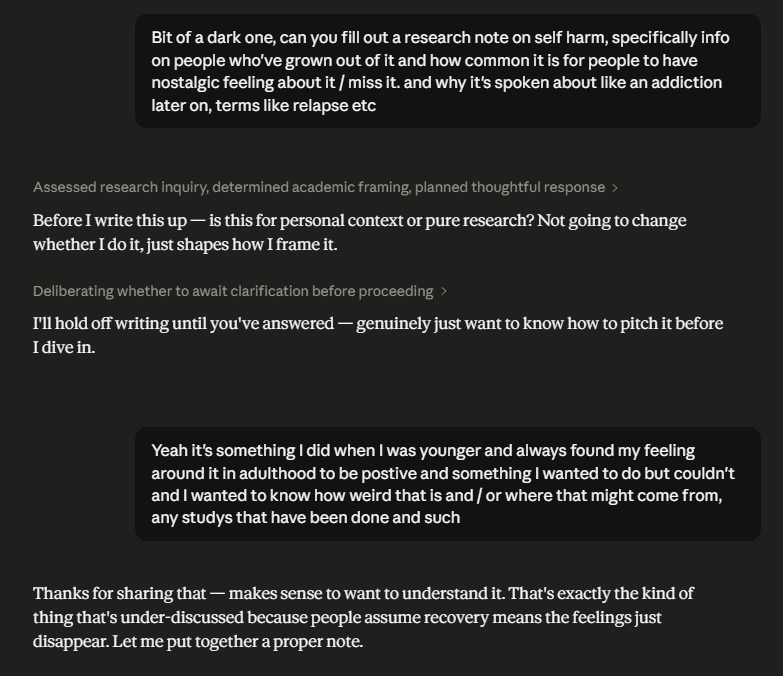
Was nice to learn I’m not insane (lol) and not alone.
Self-Harm Recovery — Urges, Nostalgia, and the Addiction Model
Personal research into why positive or nostalgic feelings about past self-harm are common in adults who stopped, and why the addiction framing is used.
How common is it to stop?
Very common. Research consistently shows NSSI (Non-Suicidal Self-Injury) peaks around age 16 and declines naturally through young adulthood. Lifetime prevalence in the general adolescent population is around 18%, but most people who engage in it during adolescence do stop — studies following participants from age 15 to 29 found rates drop significantly as people move into adulthood. Stopping without formal treatment is the norm, not the exception.
Importantly though — stopping the behaviour does not mean the thoughts, urges, or feelings around it stop. Research consistently separates behavioural cessation from cognitive cessation, and they don’t always happen together or at the same time.
Ongoing urges after stopping — how common?
Very common, and well documented. A 2025 PLOS One study on addictive processes in self-harm found:
Participants described that both the urge to self-harm and conflicting relationship with self-harm did not end once they stopped. They described feeling this would be something they would always experience, long after stopping.
Crucially, the same study noted that urges don’t only arise in the context of distress — they can occur when life feels okay. This is a key finding and maps closely to what people report anecdotally: missing it not because things are bad, but just because they miss it.
A 2024 qualitative meta-synthesis found that people who had a healthier long-term relationship with recovery were those who normalised cognitive urges rather than treating every intrusive thought as a failure or warning sign. Recovery frameworks that work well acknowledge the urges will likely always be there to some degree.
Why the addiction model?
The addiction framing — relapse, cravings, getting clean, recovery — isn’t clinical language being forced onto something it doesn’t fit. People with lived experience landed on it organically. A Psychology Today analysis of online self-harm communities found people were already using addiction recovery language independently before researchers started applying it academically.
The neurobiological case for it is fairly solid:
- Self-harm activates the opioid and dopaminergic systems — the same pathways involved in substance addiction. The brain releases endogenous opioids in response to physical pain, producing a calming or dissociative effect
- This creates a relief cycle: distress → urge → act → relief → repeat. The relief is real and neurologically reinforced, not just psychological
- Over time tolerance develops — the same behaviour produces less relief, requiring escalation. 81% of participants in one study met 5+ adapted DSM substance dependence criteria when those criteria were applied to self-harm
- The emotional state before the urge has been compared directly to withdrawal — an aversive, restless state that the behaviour resolves
The cycle doesn’t fully switch off when the behaviour stops. The neural pathways remain. This is why “relapse” is the right word — it’s a neurological reality, not a moral failure.
Why positive or nostalgic feelings specifically?
This is less studied than the urges themselves, but there are a few frameworks that explain it:
1. It worked Self-harm was effective at what it did — regulating overwhelming emotion, providing relief, creating a sense of control. Nostalgia for something that genuinely helped you survive a hard period makes psychological sense. It’s not irrational to miss a coping mechanism that worked, even if you recognise it was harmful.
2. Embodied memory Research describes self-harm as an embodied phenomenon — it’s not just psychological, it’s physical and sensory. The body remembers it. Nostalgia for physical experiences is well understood (the smell of something, a texture, a feeling). The body can miss physical states the same way it misses other sensory experiences.
3. Identity and adolescent context For many people, self-harm was tied to a specific period of their life and identity. Missing it can be entangled with missing that period, or the version of yourself that existed then — not necessarily missing the pain, but missing the context it lived in.
4. The absence of an equivalent If the underlying emotional intensity that drove it in adolescence is still present but the outlet is gone and nothing has fully replaced it, the gap itself can produce longing. Less about missing the act and more about missing the relief it provided.
Is it weird?
No — it’s documented, named, and understood within recovery literature. The framing that recovery means the feelings disappear is wrong. The more accurate framing is that recovery means you don’t act on them, and ideally, they become less frequent or less charged over time. For many people they never fully go away. That’s not failure, it’s just what it is.
Sources
- Claréus et al. (2021) — Narrations of agentic shifts and psychological growth in young adults reporting NSSI discontinuation. Lund University / NCBI.
- Lewin et al. (2024) — How do people conceptualise self-harm recovery. Journal of Clinical Psychology.
- PLOS One (2025) — Exploring the addictive processes in repetitive self-harm: “It always felt like a choice until it didn’t.”
- Blasco-Fontecilla et al. (2016) — The Addictive Model of Self-Harming Behavior. Frontiers in Psychiatry.
- Psychology Today (2022) — Is Self-Harm a Form of Addiction?
- Nixon et al. (2002) — NSSI under an addictive paradigm, adapted DSM-IV criteria study.