Yeah, I never really wanted to know
34 years old because I even tried to look into my own conditions, I preferred to work it out myself despite the horrific consequences
The robot got some nice ass sources tho, not to brag but I was pretty right about all of it.
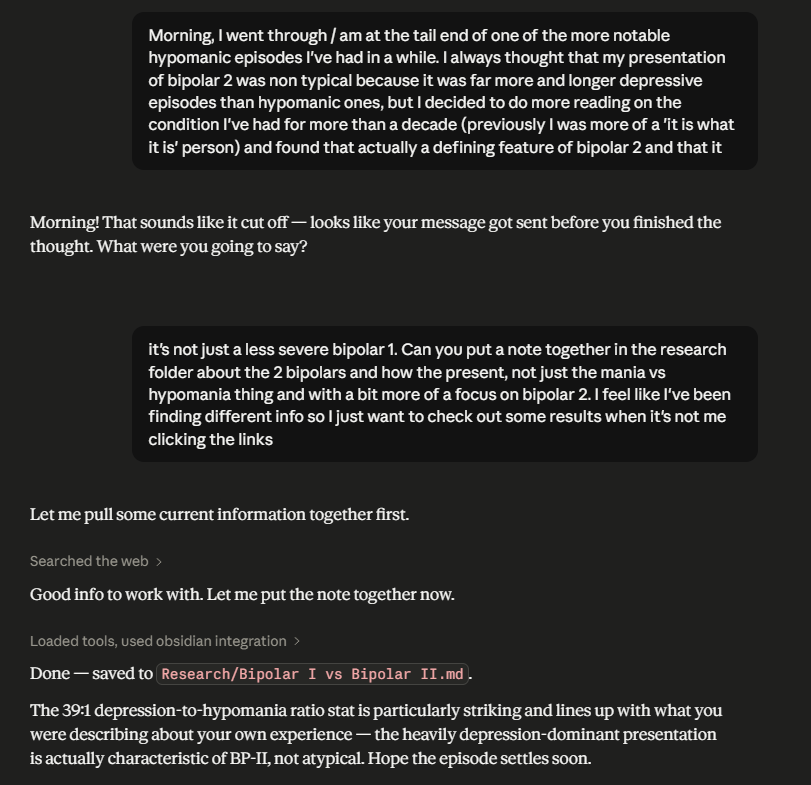
Bipolar I vs Bipolar II
A common misconception is that Bipolar II is simply a milder version of Bipolar I. Clinically they are distinct conditions with different presentations, diagnostic requirements, and illness courses — not points on a single severity scale.
The Core Distinction
The defining difference is the type of elevated mood episode:
- Bipolar I requires at least one manic episode lasting 7+ days (or requiring hospitalisation). A depressive episode is not required for diagnosis.
- Bipolar II requires at least one hypomanic episode (4+ days) and at least one major depressive episode. By definition, a full manic episode has never occurred — if one does occur, the diagnosis changes to Bipolar I.
Mania vs Hypomania
Both share the same core symptoms — elevated or irritable mood, increased energy, reduced need for sleep, racing thoughts, impulsivity — but differ significantly in severity and functional impact.
| Mania (BP-I) | Hypomania (BP-II) | |
|---|---|---|
| Duration | 7+ days | 4+ days |
| Functional impact | Significantly impairs functioning | Does not cause significant impairment |
| Hospitalisation | May be required | Not required by definition |
| Psychosis | Can occur (~50% of episodes) | Does not occur |
Hypomania can sometimes feel productive or even positive in the moment, which is part of why Bipolar II can go unrecognised for a long time.
The Depression Burden in Bipolar II
This is where BP-II diverges most from the “milder” label. Research suggests the ratio of depressive to hypomanic episodes in Bipolar II is approximately 39:1, compared to roughly 3:1 in Bipolar I. In practice this means:
- People with BP-II spend the vast majority of symptomatic time in depressive episodes
- Depressive episodes tend to be more frequent and prolonged than in BP-I
- As people with BP-II age, hypomanic episodes often become less frequent while depressive episodes continue or increase
- BP-II is frequently misdiagnosed as unipolar depression because the hypomanic episodes may not be reported or recognised
The overall disability and impact on quality of life in BP-II is considered comparable to BP-I — it is not a “less serious” condition.
Bipolar Depression: Some Distinguishing Features
Bipolar depression (in both types) can have features that differentiate it from unipolar depression, which matters for treatment:
- Earlier onset (often before age 25)
- A feeling of physical heaviness in the limbs
- Hypersomnia (sleeping too much) rather than insomnia
- Leaden paralysis or psychomotor slowing
- Episodes that are often more abrupt in onset and offset
Illness Course Differences
- BP-II tends to have a more insidious onset — the “bipolar” nature of the illness is often recognised later, with longer delays before diagnosis and treatment
- BP-I tends to present more dramatically earlier, with a higher need for early stabilisation
- BP-II carries a higher genetic loading for depression, while BP-I has more overlap with schizophrenia risk profiles
Misdiagnosis
BP-II is commonly misdiagnosed as unipolar depression, sometimes for many years. This is clinically significant because antidepressants used alone without a mood stabiliser can trigger hypomanic episodes or destabilise cycling in bipolar disorder.
Sources & Further Reading
-
Neurodivergent Insights — Bipolar 1 vs 2 (includes the 39:1 ratio with citations to Judd et al. 2002/2003) https://neurodivergentinsights.com/misdiagnosis-monday-bipolar-1-vs-bipolar-2/
-
Cleveland Clinic — Differences Between Bipolar 1 vs Bipolar 2 https://health.clevelandclinic.org/bipolar-1-vs-2
-
Healthline — Bipolar 1 vs Bipolar 2 https://www.healthline.com/health/bipolar-disorder/bipolar-1-vs-bipolar-2
-
International Bipolar Foundation — Bipolar I vs Bipolar II https://ibpf.org/articles/bipolar-i-vs-bipolar-ii-whats-the-difference/
-
GoodRx — Bipolar 1 vs 2: Mania, Hypomania, and Depression https://www.goodrx.com/conditions/bipolar-disorder/bipolar-1-vs-bipolar-2
-
PMC (peer-reviewed) — Differential characteristics of bipolar I and II: illness course and treatment response https://pmc.ncbi.nlm.nih.gov/articles/PMC10349025/
-
PMC (peer-reviewed) — Clinical and genetic differences between bipolar disorder type 1 and 2 https://pmc.ncbi.nlm.nih.gov/articles/PMC7801527/
-
PMC (peer-reviewed) — Bipolar II compared with bipolar I: baseline characteristics and treatment response https://pmc.ncbi.nlm.nih.gov/articles/PMC4788818/
Note: This is a personal reference note compiled from clinical sources. Not medical advice.